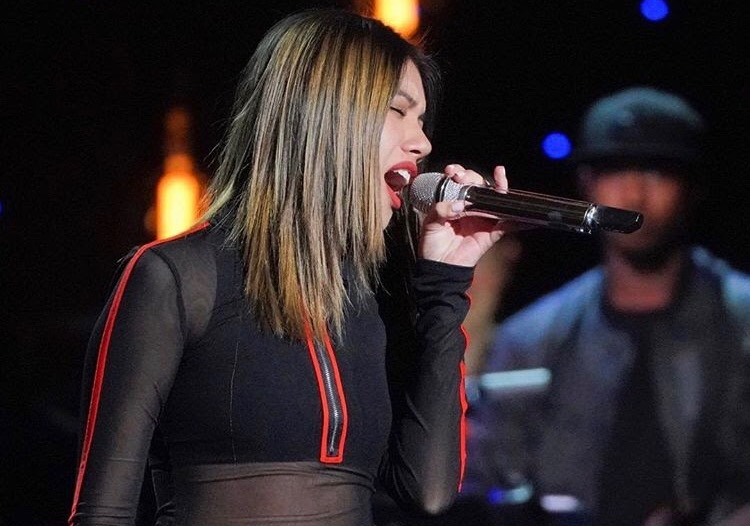
One of the most successful forms of television has always been the reality competition show. However, perhaps the most popular subset quickly became the variety talent show. Something about people of all ages and backgrounds showcasing their talents for thousands has captured the hearts of the American public, and none of these shows show any sign of slowing down. The contestants that usually stand out to most viewers are the younger ones, the ones that make you drop your jaw and wonder how someone can have so much of a natural gift at such an early age. TV Wasteland sat down with two such contestants, Darian Baena of American Idol and Sophia Borelli, who was one of the leading soloists of the Voices of Hope choir on America’s Got Talent.
On their respective roads to filming, there was one word that kept being repeated by both girls: fast. Every song had to be vetted for rights and image, and all of the rounds’ music had to be ready all at the same time. This turned out to be especially difficult for Sophia’s choir director, who had to hastily arrange ten songs for a seventy-person group, (no small feat). Many of these songs also didn’t even end up being performed, but the most important thing emphasized during this entire process was the fact that everything needed to be polished, and if something didn’t fit the image that producers wanted to create for them, it wouldn’t be chosen.
One of the most essential jobs for these shows is the talent scout. Most contestants are recruited by a talent scout hired by a record label, or a producer whose job it is to look online for people with strange or fantastic talents. Borelli and the Voices of Hope were found by one such producer, who was impressed by the videos that they had posted on YouTube. Most acts are required to audition in person for producers, but when a group of seventy children is involved, it becomes difficult to coordinate traveling for an audition. So Voices of Hope was allowed to send in videos instead, and when they were brought on to compete on the show, Borelli recounted that “the first [in-person] audition we did was the one that was aired for the first round, which is unusual.”
Baena’s experience on American Idol started out the same, with an open call at a shopping mall. Darian specifically recalled everyone there buzzing about the fact that American Idol was doing an event, and while she was allowed to tell people that she was going out for the show, she was forbidden from telling them if she had gotten on.

Sophia and Darian both remembered their first time performing on camera as completely surreal. “I don’t remember actually singing,” Borelli said, and even though they had been prepared on everything that would happen and what the judges would say to them, she recalls almost nothing from the performance itself. She was nervous among all of the insanity going on backstage, but as soon as the music started, she felt completely comfortable. Baena echoed this, claiming that “all the nerves just went away” and that she slipped into a state of complete relaxation as she performed “Angels” by Robbie Williams for the judges. Later on, she would describe getting her Golden Ticket to Hollywood as something similar, a moment that she consciously knows happened but retains no memory of.
And once the cameras started filming, image was everything. With on-camera interaction between contestants kept to a minimum (likely to maximize air time for performances), producers had to find other ways to get to the human aspect of these shows. After all, people love the shiny costumes and the high notes, but every audience craves that personal angle, something to root for (or against) in every person. And while it depended on what producer happened to be behind the camera that day, there was a bit of that craving in all of the people working on the show as well.
While the performers were never given a script to memorize or a line to say, they would often be guided in a certain direction by the questions asked or the music played during an interview. “There were some that were there just to get all the juice out of you, all the drama,” Darian said, adding that they “wouldn’t stop until they felt satisfied that they had all the emotion drained out of you.” On Idol, she was filmed from the moment she stepped out of the hotel to the minute she returned to it, constantly being asked about how she was feeling and how she was reacting to everything around her. On AGT, the “whole goal was to make one person cry, and once that happened, they were done with the interview.” Again, no one was pushed to say anything that wasn’t true, but producers would ask leading questions like “Does anyone feel singing is their only safe space?” or “Does anyone have absent parents?” All attempts to draw out something sentimental that would create connections to viewers at home. They would sometimes even play dramatic or melancholy music in the background of an interview to give it an angle that may not be evident with just the words. However, if they sensed that any contestant was uncomfortable or didn’t want to talk about a certain topic, they wouldn’t push anything that they could feel was off-limits.

One place where the two girls both found solace was with their respective vocal coaches. These were professionals assigned by the show, but their sessions were private and away from all the cameras. While they were “harsh and real with you,” they truly believed in their contestants as well. Darian’s main goal going on the show wasn’t the fame or attention it would bring, but the opportunity “to improve as an artist, play around with music, and sing.” She remembered her time with her coach as a safe space where she felt welcome and supported. Sophia’s choir director still stays in contact with their own coach, and she found his help to be something real to hold onto, a special place where they didn’t have to be scripted.
As the weeks of competition went on, it began to take a toll on both teens. The longer they were there, the more stressful it got. Sophia wasn’t really worried too much about losing, more about just messing up in front of everyone after their endless hours of hard work. She was relieved to be part of a group, though, as they all could share the burden and help each other through. A positive environment was key to getting through it all, though she did note more extreme pressure on the solo acts. This, of course, reflected Darian’s experience. While she found a community with her “competitors” that provided a strong base of positive support, the stress did sometimes become overwhelming, and the break room became a common place to recenter and get her strength back.
Especially on Idol, producers and judges made sure that everyone knew that they were going to be watched by millions of people across America. However, it didn’t really “hit” Darian until the day before the first episode aired of just how many people would be seeing her sing on television. As it began to air on the east coast (three hours before Darian herself even saw it), her phone began to blow up, hundreds of people praising her for a performance that she herself hadn’t even seen yet. While it was a lot to handle at the time, she admitted that she was happy, as “exposure is great, especially if you want to put your music out there.” Sophia made it a goal of hers to distance herself from all of the commentary: “They’re on the other side of the TV… as long as I don’t mess up, they won’t have anything truly negative to say about me.” With all of that in mind, the few negative comments she received became impersonal, simply judgment from people who didn’t understand.
In terms of sacrifices made for the show? Emotional vulnerability was a significant one. While “the experience was worth it,” Baena found trouble in being open about her story and her experience. Of course, as high school students, school became an obvious conflicting issue as well. Both girls’ grades were impacted by their time away from class, but we’re sure that most colleges will understand their unique situation.
Through all of this, the most fascinating thing about Darian and Sophia’s stories was all of the secrecy surrounding their legal situation. In the age of widespread social media, it doesn’t take long for one slipped detail to ruin the carefully kept silence around eliminations and winners. They were given certain dates when they could announce certain things, and anything that would reveal the events of an episode that hadn’t been aired was absolutely forbidden. In fact, one social media manager’s entire job was to follow every contestant’s Instagram and be one of the first to see every post, story, and comment.
According to Baena, the American Idol system was incredibly strict. Until the winner of their respective season released their own music, every contestant had to keep their own projects under wraps. Darian was not permitted to sign to any label or participate in any televised event for a year, emphasizing that “they don’t want you to outshine the winner.” She didn’t make it to the live rounds, so she was not under as many restrictions as those who continued further, but if you reached the top ten, any music you made was owned by Idol.
Ultimately, the main thing that Sophia and Darian highlighted time and time again was how lucky they felt to be on the show. As such musically driven people, they cited Idol and AGT as incredible opportunities that they will draw from for years to come. The world of reality competition shows is a complex and sometimes strange one, but if you can take the right things from it (as Baena and Borelli obviously did), it is obviously a rewarding and inspiring experience.
 TV Wasteland