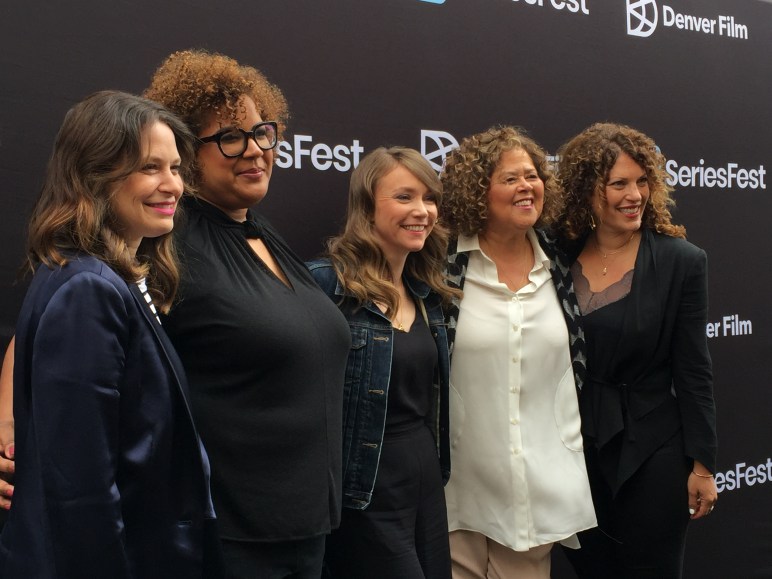
By Ryan Flaherty
We chatted with the women of Shondaland to discuss how they got into the company and what they want teenagers to know about the industry.
Katie Lowes
How did you come from your background of theater to working with Shondaland and launching your own podcast as well as acting?
I’ve always wanted to be an actor, I came out of the womb just wanting to sing and dance and act and perform for people and I was really lucky to have a family that supported that, and they really believed in arts and believed in my passion for wanting to do that. I went to college at NYU Tisch School of the Arts, I studied drama, and when I graduated it was a serious struggle to pay rent and I was doing all of the odds and ends jobs you hear about, like waitressing and babysitting and being in catering and being a person assistant and nannying and everything you can manage to pay you rent. I lived in New York City, and I got the idea that maybe if I moved to L.A. I would have better luck so I moved to Los Angeles and I was still a waitress, still a babysitter, still a caterer, still a nanny, but I was really lucky to have a strong work ethic and I’m very resilient and I don’t give up easily, so I kept auditioning while having all of these side jobs. Slowly but surely I got one line on a TV show, then two lines, then three, then a scene, then a couple scenes, then a pilot that didn’t go, then a pilot that went but got cancelled after nine episodes, and finally I was a guest star on Private Practice, which was one of Shonda Rhimes’ shows, and then a guest star on Grey’s Anatomy. I started getting into auditions for Shonda Rhimes until she gave me Quinn on Scandal when I was twenty eight, and it changed my life but I was also ready for it. I think if it had come a day sooner I probably would’ve messed up that opportunity but all of the trials and tribulations that I had had to get to that point was what made it the perfect timing, I was ready for success like that and my acting craft was at a place where I was ready to show off what I knew I could do. That was eight years ago, and what’s been so beautiful is while I was on Scandal the culture of Shondaland was to nurture humans, and so [Shonda] saw that I ran a theater company in LA with all of my best friends and she would come to the shows and she would help support my theater company and then when I got pregnant with my son she thought I would be a great host for a talk show about moms because I’m a real mom and I want to talk about real stuff and I don’t want to sugarcoat things and I don’t want to pretend like I know things when I don’t. So Katie’s Crib has been very successful for them as a podcast and now here I am at SeriesFest 5 in Denver!
What advice do you have for young women who are trying to get into the industry?
For me, hard work is obviously key. I’m not a fan of showing up late, I’m not a fan of people who call themselves actors or directors but don’t do something every day like a 9-5 where you’re devoted to doing things to further that dream every day. It’s one thing to be a dreamer, it’s another thing to be a doer, and I feel like people have to be doers. I’m also just always a fan of being in class- I’m a huge student of life, I’m a huge student of acting. I’m in class right now and I’m never not in class so whether you’re a director or an actor or a producer I think it’s important to always be studying and bettering yourself no matter how successful you are.
Akua Murphy
You run short form content for Shondaland, what was your journey to get to where you are in the industry?
It’s been a long journey. After I graduated college I moved to New York and I was working at a film studio in their TV department, so it was pretty much as far as you could be from making movies which is what I wanted to do ever since I was a kid. After that I decided I wanted to get closer to where the action is so I went to grad school and went to USC, into their producing program which is a program all about producing for TV and movies and that was a life changing experience because I met so many wonderful people and I learned how to tell stories. The first week of classes they’re giving us a camera and telling us ‘okay, you have to write, produce, direct your own short film.’ After that I worked in movies for a while, did a few jobs there, and I was still a little unsatisfied. I still wanted to tell stories and I was finally in Los Angeles, and so a friend of mine was like “you should really throw a wider net in terms of what you want to do, it’s not just all about movies.” That’s how I found my way to television and Shondaland- I saw a job posting and I said “that sounds right.” If I’m gonna make the jump from movies to TV I felt like Shondaland was the best place to learn that. Working with Betsy Beers, who’s Shonda’s producing partner and head of creative content for Shondland, was just the best experience ever because I got to see so many aspects of the industry. At the end of the day I still wanted to tell stories, so as we were expanding our digital department an opportunity opened up and it’s been so amazing to be an important part of building our expansion in digital! I was one of the producers on a web series we did on Scandal, I produced a Podcast with Katie Lowes, producing videos for our website, and producing PSA’s for our shows. Being at Shondaland I’ve just been able to do so many awesome things and have the opportunity to learn a lot- every day I’m learning something new. It’s like learning a new language, learning TV was an adventure. I’m learning about digital and what I think is interesting is you may not know everything there is to know and I don’t know about you but I’m on the internet constantly and you learn a lot about what works and what doesn’t work, like “why did I click on that video or why did I click on that article”? These are the questions I’m asking myself all of the time because as we’re creating our content and telling stories, we have to create something you’re gonna want to click on. I’ll send a message to people that’s like ‘would you click on this? Honest answers only.’ That’s how I make some decisions.
What do you want teenagers to take away from you portion of the Shondaland website, with all of your video series and your partnership with the Skim, etc.?
In a nutshell, what kind of stories are you interested in telling, and tell them. That’s what drives a lot of what we do- [the question of] what’s not out there? There’s so much out there but what are we missing, what’s our spin on it, how can we add to the conversation? Whether that’s recording something on our phone or a big fancy camera with lights, we do it all and everything in between- I’m not a snob when it comes to how we tell our stories. In fact, it’s all about trying to tell smart and authentic stories and you always have to remember that whether you’re a teenager or whether you’re grown it doesn’t matter it’s always a learning process because the kind of stories we’re telling today, obviously some are universal, but what’s important to you and what’s important to your friends, what are you guys talking about, because I’m sure you’re not really seeing it that much when you’re turning on your TV or when you’re on the internet. What you guys are talking about on Instagram or on Snap, those are the stories of tomorrow.
It’s incredible that Shondaland is making so many opportunities for women in this industry and telling their stories.
Yeah, I feel really proud to be there and incredibly lucky.
Rachel Myers
You’ve just won the Shondaland Women in Directing Mentorship, what are you most excited about working with this company?
I’ve been in the industry for a long time and over the years I’ve seen a lot of change starting to happen slowly. I feel like all of the sudden doors are opening that have been closed for a long time and Shondaland has said to be that they’re really excited about cultivating me as an artist and director within the company and I’m excited to see where that leads because there’s a lot of stories that I want to tell and I think a lot of the time it’s having the permission of somebody saying to you ‘you can do something and these doors are open to you’. That and Tribeca and the success of my movie, I’m just really grateful and the doors have opened in a really lovely way.
You’ve had this incredible journey of working in art to set design to now to directing, so how did you discover what you really wanted to do and what your passion was?
It’s funny that I’m just now getting into directing professionally because my first involvement in making work as a kid was acting as well as directing my cousins. When I was 8 years old we would do shows at family events and I was the director. I directed again in college, some theater, and I got scared because I didn’t want a conflict and I had a difficult actor and didn’t feel like I had access to the reigns and so I picked a lane that was being a designer which I had a really great career and I really love it- but now the doors are opening. My movie going to Tribeca last year was really instrumental for me because I made this little thing and I thought ‘oh it’ll go to a little film festival and it was in fifty film festivals around the world, it was on PBS, it was on topic.com and it really gave me confidence in myself to just go and do it. This little project which took like an ounce of my energy reached a lot of people and touched a lot of people and I have so many other ideas for projects and now I get to make them.
What advice do you have for younger women who are trying to enter the industry?
I think it’s a different culture now for you guys that what it was for me, I was strong and assertive but there weren’t as many women role models making things and doing things. When I meet young people I’m impressed with how direct and assertive they are about going after things that they want. I’m going to be forty next year so seeing young women do things makes you feel like oh that person is like me, I can identify with that person. I would say don’t listen to ‘no’. If you have an idea that you believe in, have the confidence to believe in your own ideas and have tenacity and the spirit to go after things that you want to make. People want to receive things, especially when it’s done well and it’s a good story and you can identify with it- you never know where it’s going to lead.
You’ve worked a lot in short and feature films, so moving to Shondaland do you think television is going to be different?
I’ve been working in TV as a production designer, I’ve done a lot of TV shows, and I have shadowed directors unofficially by working on shows as the production designer. As a production designer you’re developing the work of a show from the very beginning with conceiving the space to executing it and the schedule and the logistics so you’re sort of like a right hand to the director so for many years I’ve seen directors where I feel like you know, I can do that. I’ll stand behind the monitor while they’re giving directions and think ‘what would my note be on that take’ or ‘what’s my edit’. I was just doing it on a movie I was just on, I was on a Netflix movie. I’m excited to direct episodic television and I really want to do film and there’s just a lot of really great work happening and I’m thrilled to be able to be apart of that.
 TV Wasteland